
EBOO Machine Price: What an EBOO System Costs and What a Clinic Needs
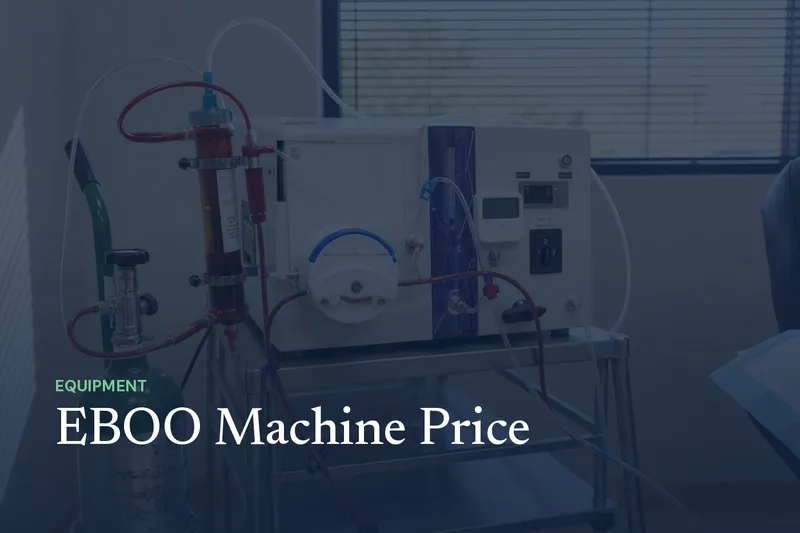
Most EBOO makers do not publish a machine price, so you ask for a quote. The only figure we found in print is a $32,000 floor price for the EBOO Pro P900 on an undated, unattributed spec sheet, and we could not verify it. Patients pay clinics about $1,800 to $4,000 per EBOO session. Beyond the machine, a clinic needs a new ozone-safe gas exchange unit for every session, medical oxygen, heparin, an emergency plan and staff time for 45 to 90 minutes with each patient.
Before you price EBOO, read why most clinics should start with standard IV ozone (MAH). It costs a fraction as much and is far easier to run.
What is an EBOO system?
EBOO (extracorporeal blood oxygenation and ozonation) takes blood out of one arm, runs it through a gas exchange unit where it meets ozone and oxygen, and returns it through the other arm. It treats a large volume of blood, typically 2 to 5 liters, in one session. A system has these parts:
- A blood pump and control unit
- An ozone generator (built in on some systems, separate on others; ask the maker)
- A gas exchange unit, often called the filter or dialyser, which is replaced for every patient
- Sterile lines and two IV catheters
EBOO is not dialysis. The filter is used to put ozone into the blood, not to clean it, and many filters in circulation are not ozone-safe because ozone breaks them down and can put microplastics into the blood. Our EBOO guide covers how it works, the evidence and the side effects.
EBOO machine price
Prices checked October 14, 2026. Where a maker does not publish a price, we say so instead of guessing.
| System | Price | Status |
|---|---|---|
| EBOO Pro P900 (Protocol4) | $32,000 floor price | Unverified. From one undated, unattributed spec sheet. No maker page confirms it. |
| Rough range on MediSkill’s IV ozone comparison | $15,000 to $60,000 | A rough estimate pending confirmation, for planning only. Not from a published price list. |
| Zotzmann, Haffner, Lewis, OZ-OXXY (names that come up for EBOO setups) | No public price found | Quote only. Ask each maker for a written quote that lists what is included. |
When you ask for a quote, get the answers in writing: what is included (pump, generator, first gas exchange units), the price of each replacement gas exchange unit, whether it is ozone-safe, what training and service come with it, and whether the maker states any regulatory status. We are not aware of any EBOO machine that is FDA-approved.
What else a clinic needs for EBOO
- Medical oxygen in a tank with a regulator. An oxygen concentrator or room air is never acceptable for IV ozone.
- A new gas exchange unit and sterile lines for every session, about $70 to $150 per session before labor (a reported figure from our IV comparison, not a quote).
- Two catheters, heparin, saline and sterile supplies. EBOO uses more heparin than MAH, so you need a clotting and medication review for each patient.
- Continuous monitoring. A nurse or practitioner stays with the patient for the whole 45 to 90 minutes.
- An emergency plan and equipment for reactions, clotting, hemolysis or air in the line.
- Patient screening. G6PD deficiency and pregnancy are absolute contraindications for EBOO. Review anemia, clotting disorders and medications too.
- Formal ozone therapy training first. EBOO builds on standard IV ozone skills.
Your total is the machine, the per-session units and lines, oxygen, supplies, and the staff time that EBOO uses up. The per-patient time is the cost clinics most often underestimate.
Start with standard IV ozone (MAH), not EBOO
EBOO is an advanced and nuanced protocol, and it takes a significant investment of time. Even if you are set on offering it, EBOO is not the starting place. Start with standard IV ozone (major autohemotherapy, MAH):
- A fraction of the price. A clinic generator for standard IV ozone runs about $5,000, with no pump, no gas exchange unit to replace and no extracorporeal circuit.
- Good results. MAH is the most studied IV ozone method, and clinicians get good results with it.
- Far fewer issues and complications. You treat a small volume of blood with one IV line and use far less heparin.
- Much easier to do. A session takes about 20 to 40 minutes, against 45 to 90 minutes of constant monitoring for EBOO.
- It may be the only modality you need. For many practices it is. Patients pay $200 to $300 for an MAH session against $1,800 to $4,000 for EBOO, so a full series is realistic for far more of them.
MediSkill teaches standard IV ozone (MAH) and considers it the gold standard of IV ozone. If you later decide EBOO fits your practice, you will already have the skills, the patients and the oxygen and monitoring routines in place. Full dosing for MAH is on the IV ozone protocol page.
MAH vs EBOO: what it takes to start
| Standard IV ozone (MAH) | EBOO | |
|---|---|---|
| Equipment | A clinic generator, about $5,000 | Quote only; rough estimate, pending confirmation, $15,000 to $60,000 |
| Per-session consumables | Standard IV supplies | About $70 to $150 for a new gas exchange unit and lines (reported) |
| Chair time | 20 to 40 minutes | 45 to 90 minutes of constant monitoring |
| Patient price per session | $200 to $300 | $1,800 to $4,000 |
Get the free guide
The Definitive Guide to Getting Started with Ozone Therapy: methods, equipment and safety in one place.
Get the free guideLooking to get EBOO as a patient?
Search clinics near you on Find a Doc, and read EBOO therapy: benefits, side effects and cost before you book. Sessions run about $1,800 to $4,000. If that is out of reach, our free guide covers ozone methods you can do at home.
Frequently asked questions
How much does an EBOO machine cost?
Most makers do not publish a price and sell by quote. One undated, unattributed spec sheet lists a $32,000 floor price for the EBOO Pro P900, and we could not verify it. Our IV ozone comparison gives a rough estimate, pending confirmation, of $15,000 to $60,000 for planning. Ask for a written quote that lists what is included.
How much does an EBOO session cost a patient?
Clinics typically charge about $1,800 to $4,000 per session. For severe illness, 6 to 10 sessions are usually prescribed. When the illness is less advanced, 2 to 4 sessions are common.
What else does a clinic need besides the EBOO machine?
Medical oxygen with a regulator, a new ozone-safe gas exchange unit and sterile lines for every session (a reported $70 to $150 per session), two catheters, heparin, saline, an emergency plan, patient screening, and a nurse or practitioner monitoring the patient for 45 to 90 minutes.
Should my clinic start with EBOO or standard IV ozone?
Start with standard IV ozone (MAH). It costs a fraction as much, gets good results, has far fewer complications, and takes much less time per patient. For many practices it is the only modality they need.
Is EBOO the same as dialysis?
No. EBOO uses a filter to put ozone into the blood. It does not filter or clean the blood the way dialysis does.
Can EBOO be done at home?
No. EBOO and other IV ozone therapies are only done in a clinic by trained staff.
Methods, equipment and safety basics in one place. We send it to your inbox.
Check your inbox: your free guide is on its way.
Something went wrong. Please try again.