 contact@mediskill.com
Ozone Therapy Research is Quietly Exploding

Walk the floor of any major integrative medicine conference this year and count the ozone therapy sessions. You won’t need many fingers. The keynotes have moved on, the panels are thinner, and attendance at dedicated conferences has stagnated. Judging strictly by its “stage presence,” you might conclude that ozone therapy peaked during the COVID scramble and has been coasting downhill ever since.
Then look at clinic adoption and the schedules. More practices are onboarding it than ever. And when you pull the actual research record, it's not a plateau at all. It's launching.
Here is the paradox: ozone therapy has never been louder in the treatment room and never quieter on the stage.
I’ll admit, I’ve been demoralized by “vanity metrics”. I receive fewer podcast invites and speaking requests than I did five years ago. Being muzzled by a regulatory agency certainly hasn’t helped. Yet the industry is fundamentally stronger. More physicians are adopting it, patient success stories are multiplying, and companies in the space are growing. While not reflected in this data, I have firsthand seen my impact on the industry. Ultimately, my goal is to help people through non-toxic methods, and by that metric, we are winning.

So why do people come to ozone therapy in the first place?
Well, let’s look at the data I’ve personally collected: an Ask-Method survey using open-ended questions (2,248 responses), 3,289 reviews and testimonials, and 253 transcripts with group audiences. (Side note: If enough people want a deeper dive on this, I have thousands more data points I can pull and analyze. All anonymized, of course.)
The reasons are more or less consistent with what I’ve found over the years, though it depends on the type of survey and where I’m asking people:
Patients - top reasons they seek ozone
- Pain · joints · arthritis — 17.5%
- Immune / infections — 12.6%
- Cancer support — 11.3%
- Low energy / fatigue — 11.3%
- Lyme · mold · chronic — 7.7%
- Gut / digestive — 6.2%
- Autoimmune — 4.8%
- Brain fog / mood — 4.5%
- Anti-aging / prevention — 4.3%
- Cardiovascular — 3.4%
Physicians - why they adopt it
- Positive labs / seen results — 58%
- Add-on to existing IV / functional practice — 57%
- New cash service — 56%
- Help chronic / complex patients — 48%
- Differentiate the practice — 27%
- Frustrated with conventional care — 18%
- Used it personally / family — 13%
- Patients asking for it — 10%
Beyond these metrics, I’ve collected over 3,000 written and video testimonials. I’m currently compiling these success stories into a booklet titled “Ozone Works.” If I included every email, letter, and text I’ve received over the years, that number would likely exceed 10,000, but it’s frankly too time-intensive for me to track everything down. Regardless, it’s a massive and growing archive of real-world evidence.
So does ozone therapy work?
Yes. It does.
Do we know everything about it? No.
Is there a lot we’re missing? Yes.
Is it a miracle cure? Not at all.
But when you look at the literature globally:
It works.
There are certainly a few methods I’d ban from the market if I had my way. But that’s not a topic for today.
So we’ve covered why people want ozone therapy. What does it actually work for, and how do I know? I’ll get to the evidence. But the place to start is the literature itself, because the trend alone is worth seeing.

The 2020s bar has two parts: the solid blue is what’s actually been published (2020–2025), and the orange cap is the projected remainder (2026–2029) based on the recent linear growth trend. The full-decade projection lands around 1,784 papers, which is roughly 2.7× the 2010s.
Flat for the first ~50 years. From the 1940s through the 1980s, ozone therapy generated only 20–50 papers per decade.
A turning point around 1990. Publications jumped sharply, this coincides with Velio Bocci’s work, which gave the field a scientific rationale and revived interest.
Exponential ever since. 137 papers in the 1990s → 489 → 655, and the 2020s are on track for ~1,784 (about 2.7× the 2010s).
To get this, I queried Europe PMC using AI, then removed every paper unrelated to ozone therapy, the environmental and chemical literature, for example. And keep note, this does not include all publications on ozone therapy and does not include white papers. Still, it's enough to establish a trend line.
| Year | Publications |
|---|---|
| 2000 | 24 |
| 2001 | 39 |
| 2002 | 30 |
| 2003 | 32 |
| 2004 | 69 |
| 2005 | 54 |
| 2006 | 45 |
| 2007 | 62 |
| 2008 | 64 |
| 2009 | 70 |
| 2010 | 58 |
| 2011 | 60 |
| 2012 | 52 |
| 2013 | 56 |
| 2014 | 60 |
| 2015 | 49 |
| 2016 | 68 |
| 2017 | 70 |
| 2018 | 98 |
| 2019 | 84 |
| 2020 | 139 |
| 2021 | 136 |
| 2022 | 120 |
| 2023 | 154 |
| 2024 | 185 |
| 2025 | 189 |
| 2026 | 106 (as of July 2026) |
| Total | 2,173 |
For those of us who’ve been around ozone therapy a while, it can feel like old hat, but it’s only just getting started. (And for any academics reading this: there’s still a lot of claim-staking to be had.)
Now, someone is going to say the counts are inflated. Everyone is publishing more because AI is writing a good chunk of it and there’s a journal somewhere that will print almost anything for a fee. Fair enough. So look at the share instead of the raw count. Ozone therapy’s slice of MEDLINE grew about 8-fold between 2000 and 2024, from roughly 0.8 to 8 papers per 100,000. Ozone’s share went up, which means researchers are choosing it at a higher rate. And the climb started before AI.
We’re at the start of this. The trials that will define the field haven’t even been run yet.
The other interesting thing about the literature is how wide a breadth of topics it covers, as the figure below shows.

My skeptical brain at this point would say, "So what? We have literature on a lot of things, and volume on its own doesn’t prove much. Is there actually good evidence that it works?"
Ranked strongest-first, here’s an analysis of 949 medical ozone-therapy studies (2000–2026). Star ratings reflect the quantity and quality of human evidence plus the consistency of results.
| Indication | Studies | Human RCTs | % Favoring Ozone | Evidence Tier | Strongest Verified Result |
|---|---|---|---|---|---|
| Low-back pain / disc herniation (ozone injection) | 131 | 28 | 87% | ★★★★★ | 61% vs 33% pain-free vs sham injection; superior to steroids at 6 months in a 306-patient RCT |
| Wound healing / diabetic foot ulcers | 82 | 8 | 93% | ★★★★★ | 92% vs 64% complete healing (RCT); every wound-healing RCT favors ozone; pooled RR ≈ 2.17 |
| Periodontitis / gum disease | 50 | 25 | 66% | ★★★★☆ | Added to scaling and root planing, significantly better periodontal indices at 6 months (n=90); antifungal action chlorhexidine lacked |
| Bone & oral surgery healing (± laser) | 56 | 18 | 86% | ★★★★☆ | Increased blood perfusion, reduced post-op pain and wound area vs control |
| Knee osteoarthritis (intra-articular) | 43 | 13 | 58% | ★★★★☆ | Meta-analysis: significant pain reduction, SMD −28.5, p < 0.001 |
| Oxidative stress & systemic mechanisms | 192 | 10 | 83% | ★★★★☆ | Improved glycemic control and fewer amputations than antibiotic control (n=101); reduced oxidative-stress markers, no side effects |
| Dentistry & broad clinical use (case series) | 174 | 7 | 81% | ★★★☆☆ | Largest real-world signal in the field, spanning dentistry and general practice |
| Nerve injury & ischemia-reperfusion | 36 | 1 | 97% | ★★★☆☆ | Near-unanimous benefit, still mostly preclinical |
| Organ protection (liver/kidney models) | 88 | 0 | 93% | ★★★☆☆ | Consistent protective signal driving translational work |
| COVID-19 / respiratory | 33 | 3 | 75% | ★★★☆☆ | Smallest theme; positive adjunctive signal |
Field totals: 949 studies · 113 randomized controlled trials · 91 systematic reviews and meta-analyses. The majority of studies report findings that favor ozone, against just 46 that find no difference.
Here is how that literature lines up with what people actually use ozone for.
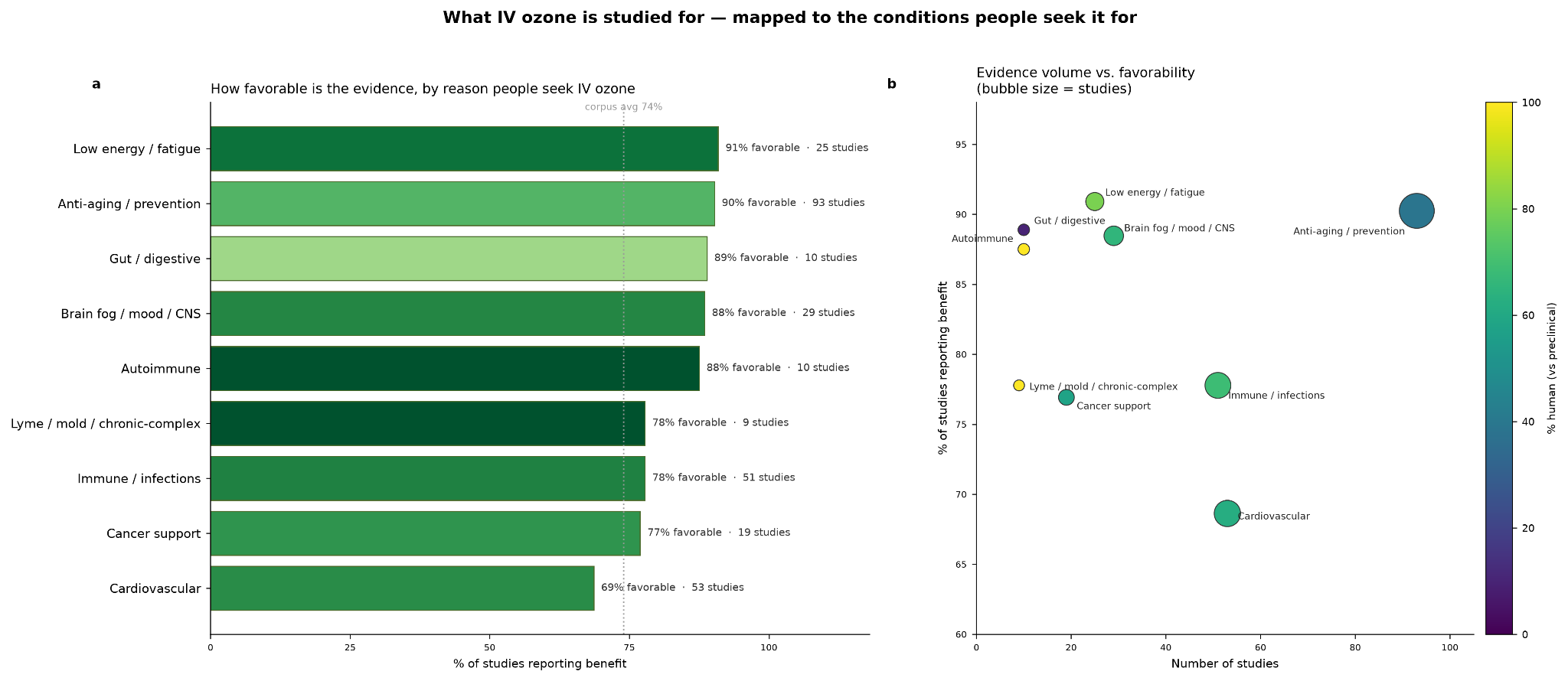
This is a bird’s-eye view of what the literature covers and which way it leans. It is not a verdict on any single condition. A bar that reads “cancer support, 77% favorable” does not mean ozone treats cancer, or that 77% of cancer patients improve. “Cancer” is an enormous umbrella, and a favorable result could mean many things, like a lab marker moving in the right direction. So, this chart really only means one thing to me - there is some literature on what people are seeking it for. I have other articles that go deeper into each one.
With all of that sitting on the table, the usual reasons people wave ozone off start to look pretty thin. If I could change how conventional skeptics think about it, these are the assumptions I’d fix:
- “Non-FDA-approved means it doesn’t work” → Nobody has taken it through FDA approval. That’s a different thing entirely.
- “The FDA says it has no known medical benefit” → They take a stronger stance due to environmental ozone but haven't received approval for ozone therapy so they put out a broad sweeping statement.
- “There’s no clinical evidence for ozone therapy” → You haven’t looked at the literature.
- “Ozone therapy is dangerous” → You’re most likely citing environmental-science literature with people breathing pollution and smog, not receiving ozone therapy.
- “Ozone therapy is quackery” → Lazy.
More ozone therapy research is being published right now than in any year on record, and the line is still climbing. The questions that matter most haven’t been answered yet. The reviews that will settle them haven’t been written yet. Most of the clinicians and patients who will ever touch ozone therapy still haven’t.
Despite being over 100 years old, we are near the beginning of adoption of ozone therapy.
Get Started with Ozone
.png)

