 contact@mediskill.com
IV Ozone vs Rectal Ozone Therapy

Quick answer: IV ozone therapy is the more potent single session, but rectal ozone insufflation delivers a comparable systemic effect, can be done at home several times a week, and costs a fraction as much per session. Most people get the best results by doing both.
Both IV ozone (major autohemotherapy, or MAH) and rectal ozone insufflation are systemic ozone therapies. Systemic means the whole body benefits, not just the spot where the ozone touches. They are the two most common ways to get that systemic effect, and the question we hear most is: which one is better?
The honest answer is that they are not competitors. They reach the body through different doors, they do some things the other cannot, and they compound when combined. This article compares them on effectiveness, mechanism, cost, frequency, and safety so you can decide which one fits your situation.
IV ozone vs rectal ozone at a glance
| IV ozone therapy (MAH) | Rectal ozone insufflation | |
|---|---|---|
| Effect | Systemic, blood-first | Systemic, gut-first, plus direct gut and liver benefit |
| Where | Clinic only | Clinic or at home |
| Potency per session | Highest | Lower per session, made up for with frequency |
| Typical frequency | 1 to 2 times per week | 2 to 5 times per week, depending on need |
| Time per session | 45 to 90 minutes including travel and setup | Under 5 minutes |
| Cost per session | $150 to $300 (MAH); $400 to $1,800 for high-dose forms | $30 to $100 in a clinic; cents per session at home after equipment |
| Needle required | Yes | No |
| Best for | Loading dose, acute situations, maximum stimulus | Maintenance, gut and liver support, consistency, value |
What is the difference between IV ozone and rectal ozone therapy?
The difference is the door the ozone comes through. IV ozone is blood-first. Blood is drawn, mixed with an oxygen-ozone gas, and returned. Red blood cells get the strongest immediate exposure, and circulating immune cells meet the ozone byproducts directly. That makes it the fastest, most uniform systemic stimulus available. There are several forms, from standard MAH to high-dose, 10-pass, and EBOO, which we break down in our comparison of IV ozone therapies.
Rectal insufflation is gut-first. A small volume of oxygen-ozone gas is introduced into the rectum with a catheter or bag. The ozone reacts within seconds at the colon lining, and the byproducts drain two ways: through the portal vein to the liver, and through the systemic veins to the rest of the body. That dual drainage is why rectal ozone is both a gut therapy and a systemic one, not a watered-down IV.
Neither method puts ozone itself into circulation. In both cases the ozone is consumed almost instantly and the body responds to a brief pulse of messenger molecules, mainly hydrogen peroxide and lipid oxidation products [1, 2]. What differs is which tissue receives that pulse first.
Is rectal ozone really 95% as effective as IV ozone?
You will see the figure "95% as effective as IV" quoted across the ozone world, including on this site. It traces to Silvia Menéndez, PhD, one of the most prolific researchers in ozone therapy, who made the statement in a presentation. We want to be straight about it: that number is her clinical opinion, not a measured result. No study has produced a percentage like that.
What the research does show is that the two routes land in the same neighborhood. There are two head-to-head comparisons we know of, and both point the same way.
The first is a 2016 Italian study in metabolic syndrome. Forty-eight adults were assigned to MAH or rectal insufflation, 24 per group, without reported randomization. Both groups received 15 sessions, twice a week. The rectal group got 200 mL of gas at 20 µg/mL per session; the MAH group had 200 mL of blood treated with 100 mL of gas carrying about 4 mg of ozone. Waist circumference, glucose, triglycerides, HDL cholesterol, blood pressure, and C-reactive protein were tracked, though the results were presented mainly as graphs. The authors called the two sets of results "almost equivalent" and concluded that rectal insufflation can stand in for MAH in people who cannot do IV [3].
The second is a 2018 Cuban report in chronic venous leg ulcers, presented as a conference abstract by Dr. Menéndez's group. Ninety hospitalized patients with ulcers present for more than two years and at least 5 cm across were split 30 per arm into MAH, rectal insufflation, or conventional care. Mean hospital stay was 31.5 days in both ozone arms versus 53.1 days with conventional care. The two ozone routes performed identically on that measure. Because it is an abstract, the randomization method is not described, so treat it as supportive rather than definitive [27].
Zooming out, a 2016 evidence review classified both routes under evidence-based medicine after examining more than 11,000 MAH treatments in 577 patients and about 47,000 rectal insufflations in 716 patients. Both were judged effective, safe, and economical [4].
So the instinct behind "95%" is roughly right: rectal ozone is close to IV in systemic effect. But the more useful way to think about it is that they have different, complementary angles of attack, which the next section covers. For the full argument for why home ozone belongs alongside clinic ozone, see The Clinical Case for Prescribing Ozone at Home.
What does each route do that the other cannot?
IV ozone wins on direct red blood cell exposure and speed of systemic activation. Rectal ozone reaches four things IV never touches: the gut microbiome, the intestinal barrier, the gut's immune tissue, and first-pass exposure of the liver [1, 5, 6, 7].
| Mechanism | IV / MAH | Rectal insufflation |
|---|---|---|
| Red blood cell oxygen delivery | Direct, strong | Indirect |
| Systemic immune activation | Immediate, uniform | Slower, different profile |
| Microbiome remodeling | No direct effect | Direct, unique advantage |
| Intestinal barrier repair | No direct effect | Direct |
| Gut mucosal immunity (GALT) | Indirect | Direct |
| Liver exposure | Good, diluted | Concentrated first pass via portal vein |
| Antioxidant (Nrf2) activation | Faster, uniform | Slower, liver-weighted |
A few measured rectal outcomes make the point that "gut-first" is not "weaker." In a randomized trial of 60 people with rheumatoid arthritis, adding rectal ozone to methotrexate produced a greater clinical response and better antioxidant markers than methotrexate alone [8]. In a 40-person randomized trial in IgA deficiency, rectal ozone produced a complete response in 85% of participants versus 45% with the comparison treatment [9]. And a 34-person study using rectal insufflation three times a week for 90 days reported improved dysbiosis symptoms [6]. None of these are IV results. They are things rectal ozone did on its own.
What has each route been studied in and used for?
Both routes have been studied in published human trials, and both are used day to day in integrative practices for chronic, inflammation-driven, or oxidative-stress-driven problems. Here is a short list of examples for each. These are studies, not promises, and several are small or preliminary.
IV ozone (MAH) has been studied in:
- Heart failure: 40 patients, five weeks of MAH, with significant gains in antioxidant enzymes and a fall in lipid peroxidation [12].
- Tumor oxygenation in cancer patients: an 18-person pilot by Dr. Bernardino Clavo's group showing improved oxygenation in the most hypoxic tumors [13].
- COVID-19 pneumonia: a prospective case-control study of hospitalized patients [14], and a pilot randomized trial in post-COVID sequelae [15].
- Peripheral artery disease in dialysis patients: improved walking distance in intermittent claudication [16].
- Chronic venous leg ulcers: the same 90-patient comparison, where MAH matched rectal ozone on hospital stay [27].
- In practice it is also commonly used for chronic infections, chronic fatigue, autoimmune conditions, and general oxidative stress, which we cover in the MAH guide.
Rectal ozone insufflation has been studied in:
- Metabolic syndrome: the head-to-head comparison against MAH, 24 versus 24, 15 twice-weekly sessions, with almost equivalent results [3].
- Chronic venous leg ulcers: 90 hospitalized patients, 30 per arm; rectal ozone and MAH both cut mean hospital stay from 53 to about 32 days versus conventional care [27].
- Rheumatoid arthritis: randomized trial of 60 patients, rectal ozone added to methotrexate [8].
- IgA deficiency: randomized trial of 40 patients, 85% complete response versus 45% [9].
- Intestinal dysbiosis: 34 patients, three sessions a week for 90 days [6].
- Radiation-induced rectal bleeding and proctitis: two series from Dr. Clavo's group in Spain, 17 and 12 patients, with long-term control in cases that had failed conventional care [17, 18].
- Chemotherapy-induced neuropathy: Clavo's group again, with long-term improvement in pain, numbness, and tingling after rectal insufflation [19, 20], now moving into a randomized phase II to III trial [21], plus a trial of rectal ozone on the gut microbiome in pelvic radiation toxicity [22].
- Coronary artery disease: rectal ozone improved oxidative stress and clotting markers [23].
- Diabetic foot: rectal plus local ozone compared with antibiotics, from the Cuban group that includes Dr. Menéndez [24].
- Mild to moderate COVID-19: a phase 1/2 randomized trial using rectal insufflation [25].
- Fibromyalgia: an open-label pilot as add-on treatment [26].
- In practice it is the standard home route for gut issues, Lyme and other chronic infections, autoimmune conditions, mold illness, and general maintenance. See the rectal ozone guide for protocols.
Notice how much of the rectal list comes from oncology supportive care. Dr. Clavo's team chose rectal insufflation for cancer survivors precisely because it is repeatable, well tolerated, and reaches the pelvic tissue and gut that radiation and chemotherapy damage. That is the same logic that makes it the right home route for almost everyone else.
How much does IV ozone therapy cost compared with rectal ozone?
IV ozone runs $150 to $300 per MAH session, and $400 to $1,800 for high-dose forms. Rectal ozone runs $30 to $100 per session in a clinic, or roughly $1,200 to $2,200 one time for a complete home setup that then costs cents per session. Home is the better option for almost everyone, because the whole point of rectal ozone is frequency, and frequency is only practical at home.
| Option | Typical cost | Notes |
|---|---|---|
| IV ozone, standard MAH | $150 to $300 per session | Most common IV form, done in a clinic |
| IV ozone, high-dose forms | $400 to $1,800 per session | HiDose, 10-Pass, and EBOO; see Comparing IV Ozone Therapies for what each one costs and why |
| Rectal ozone in a clinic | $30 to $100 per session | Practical for a trial run, not for daily use |
| Rectal ozone at home | $1,200 to $2,200 one time for equipment | Generator, regulator, oxygen, accessories; then consumables and oxygen refills |
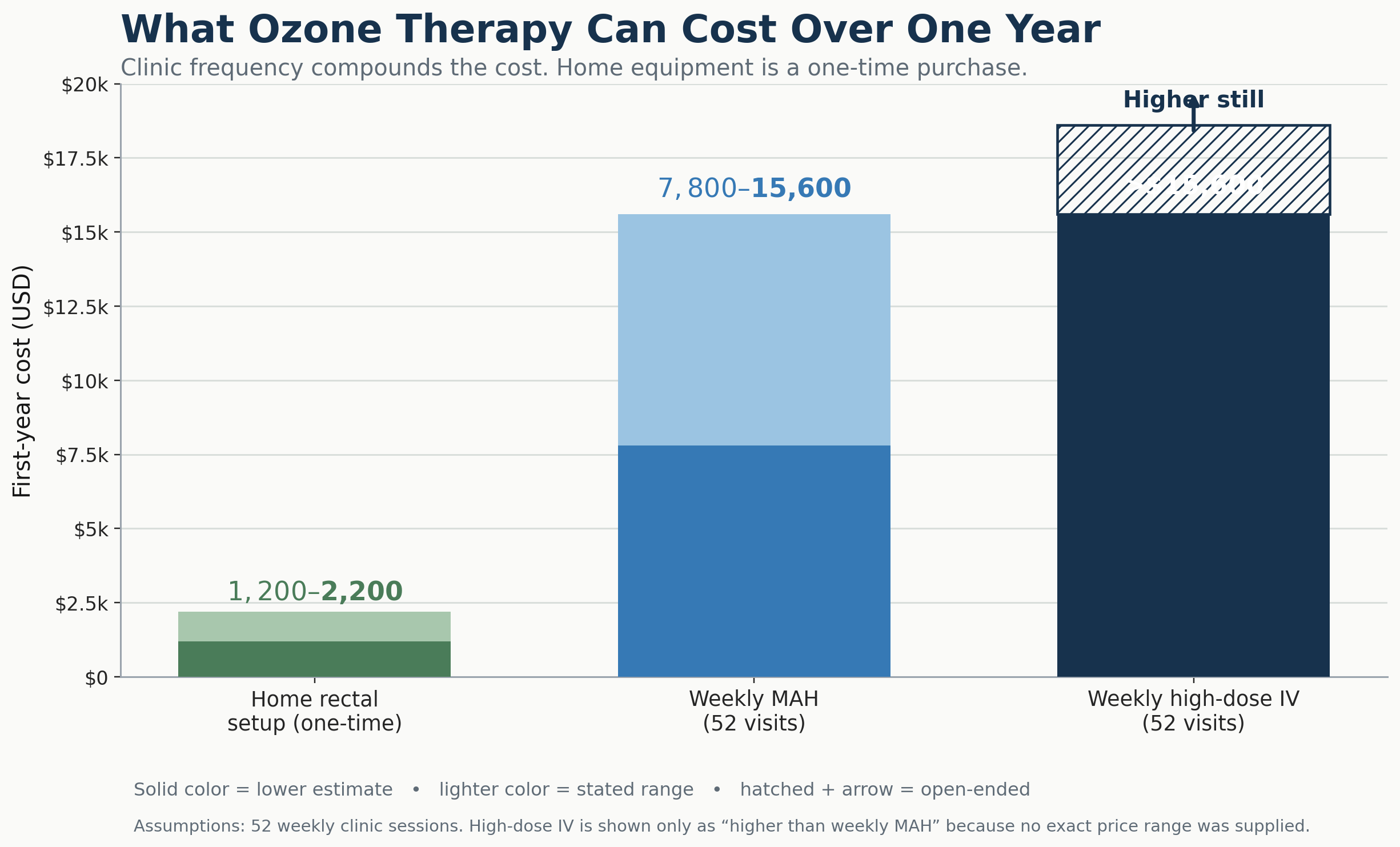
Here is what that means over a year. One MAH session per week at $150 to $300 adds up to $7,800 to $15,600. A home rectal setup at $1,200 to $2,200 is paid for by the second or third month, and the same equipment also handles ozonated water, ear insufflation, vaginal insufflation, and limb bagging. Our guide to choosing an ozone therapy machine for home use covers what to look for (and why a cheap machine is a false economy), and Comparing Home Ozone Therapies covers everything else the machine can do.
Insurance rarely covers either route. Budget as if you are paying out of pocket.
Why does frequency matter more than potency?
Ozone is a frequency-dependent therapy. A single session is a stimulus, like a workout, and the benefit comes from adaptation to repeated, well-spaced stimuli rather than from any one dose [1, 2, 10].
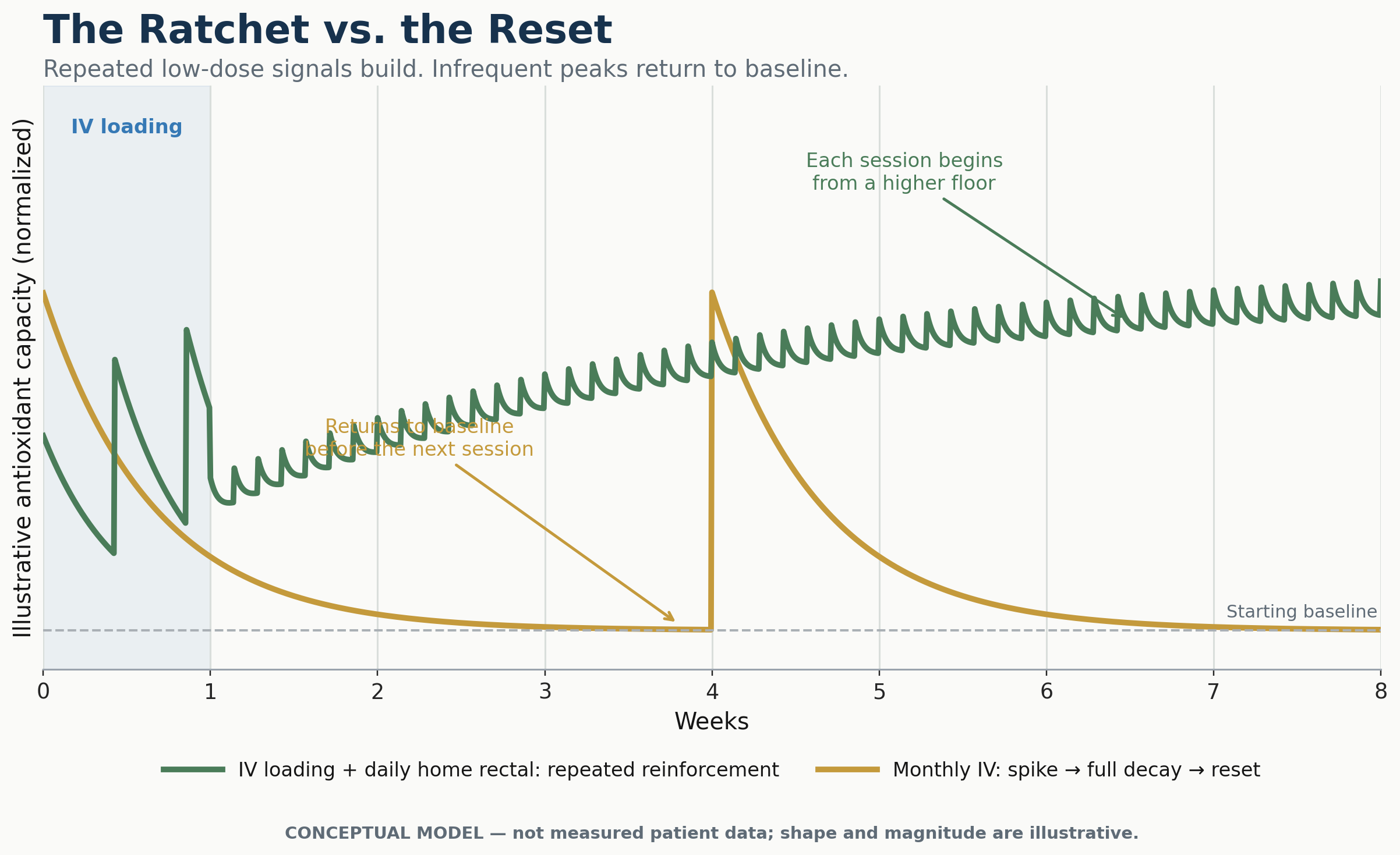
Here is the mechanism in plain terms. The ozone pulse briefly dips the body's antioxidant status, and within about twenty minutes it recovers [1, 2]. Over the following hours and days the cells respond by making more of their own antioxidant enzymes through the Nrf2 pathway [10, 11]. That adaptation peaks and fades over roughly one to three days. If the next session lands while capacity is still elevated, it starts from a higher baseline and the gains ratchet upward. If sessions are weeks apart, each one resolves completely before the next arrives and you get repeated starts instead of cumulative progress.
The human data support the course-level effect. In 40 people with heart failure treated with MAH for five weeks, superoxide dismutase rose 13.8%, catalase 20.9%, glutathione peroxidase 21.0%, and glutathione 27.7%, while the lipid peroxidation marker MDA fell 26.8%, all statistically significant [12].
This is where rectal ozone earns its place. Very few people can get IV ozone more than once or twice a week, and many get it monthly. Rectal insufflation can be done at home two to five times a week, depending on need, and many protocols cycle three weeks on, one week off. Even if each rectal session is a smaller stimulus than an IV, three to five sessions a week is a training program. One IV a month is not. The old line on this page put it bluntly: 30% efficacy times five sessions a week, you do the math.
Which one should you choose: IV ozone or rectal insufflation?
If you can do both, do both. IV is the loading dose, and rectal is the maintenance dose that holds the gain between visits, keeps the adaptation from decaying, and covers the gut and liver axis the IV never reaches.
Lean toward IV ozone if:
- You want the strongest possible single stimulus and have a practitioner nearby.
- You are in an acute situation where speed of systemic effect matters most.
- You are starting a course and want to load quickly before switching to home maintenance.
Lean toward rectal insufflation if:
- Consistency matters more than intensity, which is most chronic situations.
- Gut, microbiome, or liver support is part of what you are after.
- Cost, travel, or a difficult stick makes weekly IV impractical.
- You want one piece of equipment that also does ozonated water, ear, vaginal, and topical applications.
If you had to pick only one, rectal insufflation has the better overall value: similar systemic benefit, far more practical, and far cheaper per session. Just like diet and exercise, ozone therapy rewards consistency, and rectal is the route you can actually be consistent with.
How often can you do IV ozone vs rectal ozone?
IV ozone is typically done once or twice a week during a loading phase, then weekly to monthly for maintenance. Rectal insufflation is typically done two to five times per week depending on need, more often during a loading phase and less during maintenance, with cycles such as three weeks on and one week off.
Across the randomized trials we have reviewed, systemic protocols cluster around every-other-day to three-times-weekly loading followed by weekly or twice-weekly maintenance. Doing too little is the common failure. Doing too much is rare and would require very high doses or twice-daily sessions. Dose matters as much as frequency, and our guide on how to calculate an ozone dose walks through concentration and volume for each route.
Is rectal ozone safer than IV ozone?
Both routes have strong safety records when done correctly, and rectal has the strongest record of any non-IV application. The 2016 evidence review found no serious adverse reactions across roughly 47,000 rectal insufflations in 716 patients and more than 11,000 MAH treatments in 577 patients [4]. Rectal side effects, when they occur, are mild and transient: gas, brief cramping, or an urge to have a bowel movement.
IV ozone carries the ordinary risks of any IV procedure, which is why it belongs in a clinic with trained staff, sterile technique, and ozone-resistant materials. Rectal insufflation involves no needle and no blood handling, which is a large part of why it is the standard home route. Our safety of ozone therapy article covers contraindications for both.
Frequently asked questions
What is the difference between IV ozone and rectal ozone therapy?
IV ozone treats withdrawn blood with ozone and returns it, so it acts on the blood first and must be done in a clinic. Rectal ozone introduces oxygen-ozone gas into the colon, where it acts on the gut first and then reaches the liver and the rest of the body. Both are systemic therapies; rectal can be done at home.
Which is more effective, IV ozone or rectal ozone?
IV ozone is more potent per session. In the two head-to-head comparisons published, rectal insufflation matched IV: results were almost equivalent in metabolic syndrome, and hospital stay was identical in chronic venous ulcers. Because rectal can be done far more often, many people get equal or better cumulative results from it.
Is rectal ozone 95% as effective as IV?
That figure is the clinical opinion of researcher Silvia Menéndez, not a measured result. The research supports the direction of the claim, that the two are close in systemic effect, but no study has produced a percentage.
How much does rectal ozone therapy cost?
In a clinic, $30 to $100 per session. At home, a complete setup costs about $1,200 to $2,200 one time, after which each session costs cents in consumables plus periodic oxygen refills. Home is the better option because rectal ozone works through frequency, and several clinic visits a week are not realistic.
Can rectal ozone therapy be done at home?
Yes. It requires an ozone generator built for therapy use, an oxygen source with a low-flow regulator, and ozone-resistant catheters or bags. It takes under five minutes per session. See the rectal ozone therapy guide for the step-by-step protocol.
Should IV and rectal ozone be combined?
Yes, when possible. IV serves as the loading dose and rectal as the at-home maintenance dose between visits. The combination is more than additive because rectal holds the adaptation IV creates and covers the gut and liver axis that IV does not reach.
Related reading
- Rectal Ozone Therapy: What It Is, How It Works and How to Do It Yourself
- IV Ozone Therapy (Major Autohemotherapy)
- Comparing Intravenous Ozone Therapies
- Comparing Home Ozone Therapies
- The Clinical Case for Prescribing Ozone at Home
- How to Choose an Ozone Therapy Machine for Home Use
- How Rectal Ozone Insufflation Affects the Gut Flora
- EBOO: Benefits, Side Effects, and Cost
And if you want to become an ozone therapy nerd like us, check out our free guide below.
References
[1] Bocci V, Zanardi I, Michaeli D, Travagli V. Mechanisms of action and chemical-biological interactions between ozone and body compartments: a critical appraisal of the different administration routes. Curr Drug Ther. 2009;4(3):159–173. doi:10.2174/157488509789055045
[2] Tricarico G, Travagli V. The relationship between ozone and human blood in the course of a well-controlled, mild, and transitory oxidative eustress. Antioxidants. 2021;10(12):1946. doi:10.3390/antiox10121946
[3] Vaiano F, Loprete F. Large auto-hemoinfusion versus rectal insufflation in patients with metabolic syndrome. Ozone Therapy. 2016;1(1):5841. doi:10.4081/ozone.2016.5841
[4] Viebahn-Hänsler R, León Fernández OS, Fahmy Z. Ozone in medicine: clinical evaluation and evidence classification of the systemic ozone applications, major autohemotherapy and rectal insufflation. Ozone Sci Eng. 2016;38(5):322–345. doi:10.1080/01919512.2016.1191992
[5] Su Z, Lin J, Zeng X, et al. Ozone water enema activates SIRT1–Nrf2/HO-1 pathway to ameliorate gut dysbiosis in mice receiving COVID-19 patient-derived faecal microbiota. J Med Microbiol. 2025;74(9). doi:10.1099/jmm.0.002038
[6] Loprete F, Vaiano F. The use of ozonated water and rectal insufflation in patients with intestinal dysbiosis. Ozone Therapy. 2017;2(3). doi:10.4081/ozone.2017.7304
[7] Pelinsari SM, Sarandy MM, Vilela EF, et al. Ozone exposure controls oxidative stress and the inflammatory process of hepatocytes in murine models. Antioxidants. 2024;13(2):212. doi:10.3390/antiox13020212
[8] León Fernández OS, et al. Medical ozone increases methotrexate clinical response and improves cellular redox balance in patients with rheumatoid arthritis. Eur J Pharmacol. 2016;789:313–318. doi:10.1016/j.ejphar.2016.07.031
[9] Díaz-Luis J, Menéndez-Cepero S, Macías-Abraham C, Fariñas-Rodríguez L. Systemic ozone therapy by rectal insufflation for immunoglobulin A deficiency. MEDICC Rev. 2018;20(1):29. doi:10.37757/mr2018.v20.n1.7
[10] Galiè M, Covi V, Tabaracci G, Malatesta M. The role of Nrf2 in the antioxidant cellular response to medical ozone exposure. Int J Mol Sci. 2019;20(16):4009. doi:10.3390/ijms20164009
[11] Viebahn-Haensler R, León Fernández OS. Ozone in medicine: the low-dose ozone concept and its basic biochemical mechanisms of action in chronic inflammatory diseases. Int J Mol Sci. 2021;22(15):7890. doi:10.3390/ijms22157890
[12] Buyuklu M, Kandemir FM, Set T, et al. Beneficial effects of ozone therapy on oxidative stress, cardiac functions and clinical findings in patients with heart failure reduced ejection fraction. Cardiovasc Toxicol. 2017;17(4):426–433. doi:10.1007/s12012-017-9400-8
[13] Clavo B, Pérez JL, López L et al. Ozone Therapy for Tumor Oxygenation: a Pilot Study. Evid Based Complement Alternat Med. 2004;1(1):93-98. doi:10.1093/ecam/neh009
[14] Hernández A, Viñals M, Pablos A et al. Ozone therapy for patients with COVID-19 pneumonia: Preliminary report of a prospective case-control study. Int Immunopharmacol. 2021;90:107261. doi:10.1016/j.intimp.2020.107261
[15] He Y, Liu X, Zha S et al. A pilot randomized controlled trial of major ozone autohemotherapy for patients with post-acute sequelae of COVID-19. Int Immunopharmacol. 2024;139:112673. doi:10.1016/j.intimp.2024.112673
[16] Biedunkiewicz B, Tylicki L, Nieweglowski T et al. Clinical efficacy of ozonated autohemotherapy in hemodialyzed patients with intermittent claudication: an oxygen-controlled study. Int J Artif Organs. 2004;27(1):29-34. doi:10.1177/039139880402700107
[17] Clavo B, Ceballos D, Gutierrez D et al. Long-term control of refractory hemorrhagic radiation proctitis with ozone therapy. J Pain Symptom Manage. 2013;46(1):106-12. doi:10.1016/j.jpainsymman.2012.06.017
[18] Clavo B, Santana-Rodriguez N, Llontop P et al. Ozone Therapy in the Management of Persistent Radiation-Induced Rectal Bleeding in Prostate Cancer Patients. Evid Based Complement Alternat Med. 2015;2015:480369. doi:10.1155/2015/480369
[19] Clavo B, Rodríguez-Abreu D, Galván S et al. Long-term improvement by ozone treatment in chronic pain secondary to chemotherapy-induced peripheral neuropathy: A preliminary report. Front Physiol. 2022;13:935269. doi:10.3389/fphys.2022.935269
[20] Clavo B, Rodríguez-Abreu D, Galván-Ruiz S et al. Long-Term Effects of Ozone Treatment in Patients with Persistent Numbness and Tingling Secondary to Chemotherapy-Induced Peripheral Neuropathy. A Retrospective Study. Integr Cancer Ther. 2025;24:15347354241307038. doi:10.1177/15347354241307038
[21] Clavo B, Cánovas-Molina A, Cazorla-Rivero S et al. Effectiveness and cost-effectiveness of ozone treatment in patients with paraesthesia (numbness, tingling) secondary to chemotherapy-induced peripheral neuropathy: randomized, triple-blind clinical trial (OzoParQT). BMC Cancer. 2026;26(1):260. doi:10.1186/s12885-025-15399-9
[22] Clavo B, Córdoba-Lanús E, Martínez-Sánchez G et al. Modulating the Gut Microbiota via Rectal Ozone Insufflation in Gynecological Cancer Patients with Radiotherapy/Chemotherapy-Induced Pelvic Toxicity: A Proposed Clinical Study Protocol. J Clin Med. 2025;14(22). doi:10.3390/jcm14228015
[23] Martínez-Sánchez G, Delgado-Roche L, Díaz-Batista A et al. Effects of ozone therapy on haemostatic and oxidative stress index in coronary artery disease. Eur J Pharmacol. 2012;691(1-3):156-62. doi:10.1016/j.ejphar.2012.07.010
[24] Martínez-Sánchez G, Al-Dalain SM, Menéndez S et al. Therapeutic efficacy of ozone in patients with diabetic foot. Eur J Pharmacol. 2005;523(1-3):151-61. doi:10.1016/j.ejphar.2005.08.020
[25] Shah M, Captain J, Vaidya V et al. Safety and efficacy of ozone therapy in mild to moderate COVID-19 patients: A phase 1/11 randomized control trial (SEOT study). Int Immunopharmacol. 2021;91:107301. doi:10.1016/j.intimp.2020.107301
[26] Hidalgo-Tallón J, Menéndez-Cepero S, Vilchez JS et al. Ozone therapy as add-on treatment in fibromyalgia management by rectal insufflation: an open-label pilot study. J Altern Complement Med. 2013;19(3):238-42. doi:10.1089/acm.2011.0739
[27] Menéndez-Cepero S. Ozone therapy in leg ulcers of patients with chronic venous insufficiency [abstract]. J Ozone Ther. 2018;2(2). doi:10.7203/jo3t.2.2.2018.11128
Get Started with Ozone
.png)

